

Staying Strong: WB-EMS and Menopause
Jun 29, 2026
As a male in my 40s, I cannot claim to be a menopause expert, and it seems I’m not alone. It is a complex and often misunderstood biological transition highlighted by the New York Times. Because a significant portion of our members at BODY20 are currently in the perimenopausal phase, I believe it is essential to explore how we can leverage electrical muscle stimulation and targeted fitness strategies to help manage this change effectively.
The transition through menopause, typically occurring in the late 40s or early 50s, is marked by a decline in estrogen. This hormonal shift is more than a change in a lab report. It’s a systemic shift that can lead to weight gain, sleep disturbances, and joint sensitivity. To navigate this, we must evolve our training strategy, and to talk about it, I will rely on the expertise of industry leaders.
The Shift: Muscle as an Endocrine Organ
In the past, fitness advice for women during midlife often defaulted to calorie restriction or high-volume steady-state cardio. Modern research, however, demands a reframe. We must view muscle not merely as a tool for movement, but as a vital endocrine organ.
As Dr. Gabrielle Lyon, a pioneer in muscle-centric medicine, notes:
"Muscle is the organ of longevity. It is the primary site for glucose disposal, it is the primary site for fatty acid oxidation, and it is the primary driver of your metabolic rate. If you do not have adequate muscle mass, you are essentially setting the stage for metabolic dysfunction." — Dr. Gabrielle Lyon
She further emphasizes the urgency of resistance training for this demographic:
"We have to change how we think about strength—mentally, physically, and emotionally—[as] skeletal muscle is the key to longevity. Most of us are under-muscled, and our health suffers because of it." — Dr. Gabrielle Lyon
As estrogen levels decline during the menopausal transition, women often face "anabolic resistance", a state where the body becomes less efficient at stimulating protein synthesis. This makes resistance training a clinical necessity, not an optional activity based on preference.
How WB-EMS Can Help
The primary obstacle for many women in this demographic is usually lifting enough weight. To stimulate bone density and muscle adaptation, the skeleton requires mechanical loading. However, this is frequently complicated by joint inflammation or pre-existing aches and pains that make heavy lifting prohibitive.
Dr. Stacy Sims, a leading researcher in female physiology, highlights the unique necessity of intensity for this population:
"We need to create an external stressor that is significant enough to bypass the body’s desire to conserve tissue, but we must do so in a way that respects the recovery capacity of the joints." — Dr. Stacy Sims
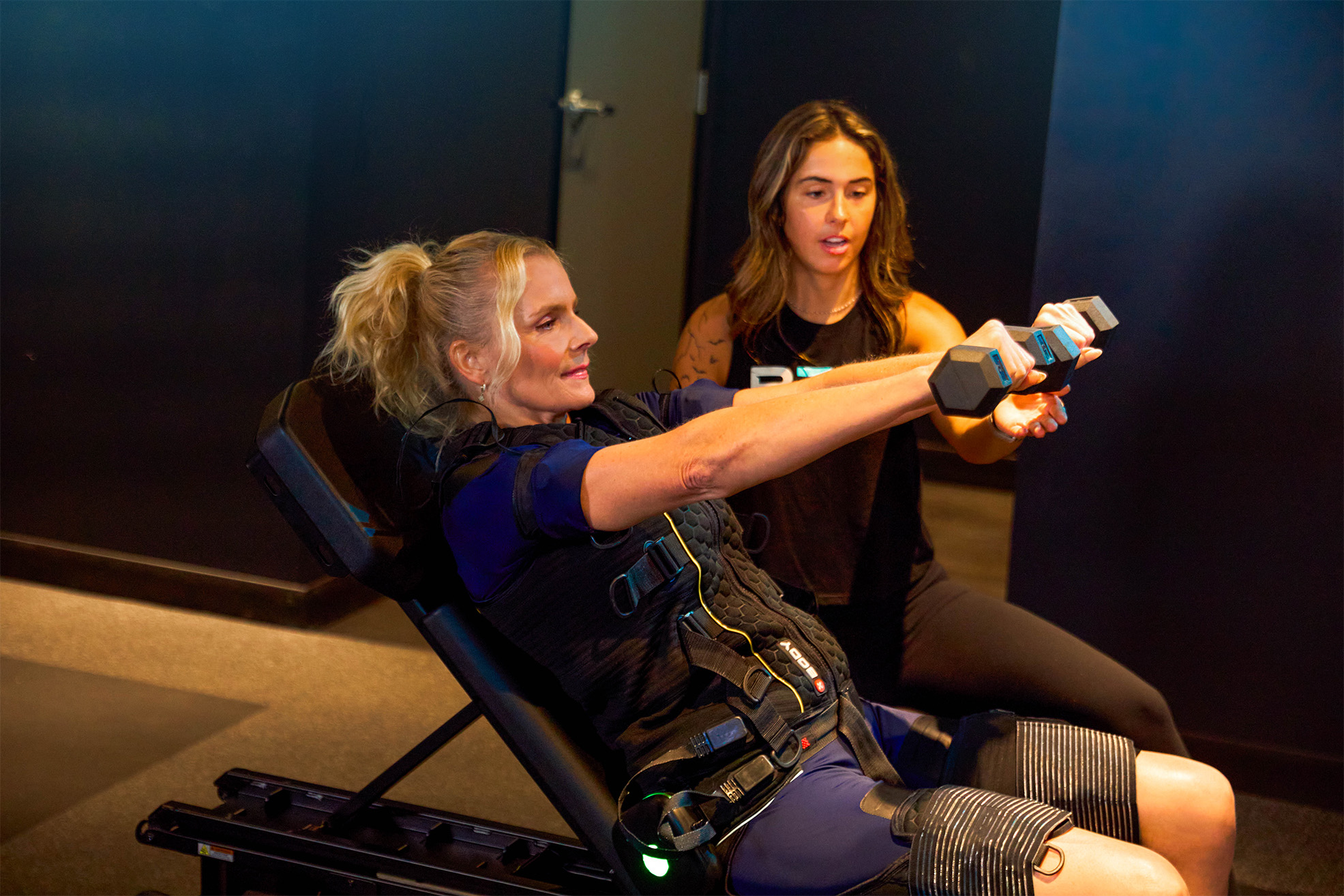
WB-EMS becomes scientifically compelling in this context. By facilitating the non-selective recruitment of motor units through electrical stimulation, we can achieve high-intensity muscular contractions without the requirement of heavy external loads that tax compromised joints.
WB-EMS Clinical Evidence:
Study 1: Effects of Whole-Body Electromyostimulation and Lifestyle Modifications on the Metabolic Syndrome in Premenopausal Overweight Women (Willert et al., 2024)
This randomized controlled trial examined how WB-EMS functions as an aid to standard lifestyle interventions for metabolic health.
- Study Population: 90 overweight or obese premenopausal women (aged 25–50). Participants were divided into three groups of 30.
- The WB-EMS Protocol: Participants performed 20-minute sessions at a frequency of 85 Hz with a 350 µs pulse width. The duty cycle was set to a 6-second impulse followed by 4 seconds of rest.
- Key Findings:
- High Adherence: The WB-EMS group exhibited the highest compliance rate and lowest dropout rate among all groups, proving it is a sustainable solution for busy lifestyles.
- Metabolic Z-Score: The WB-EMS group was the only cohort to achieve a statistically significant improvement in their Metabolic Syndrome Z-score compared to baseline.
- Sustainable Integration: WB-EMS served as a force multiplier, enhancing the efficacy of energy restriction and walking without requiring high-impact movement.
Study 2: Effects of Whole-Body Electromyostimulation on Physical Fitness in Postmenopausal Women (Frontiers in Physiology, 2020)
This trial focused on the potential for WB-EMS to improve functional independence and cardiovascular health in postmenopausal women.
- Study Population: 90 sedentary, healthy postmenopausal women (aged 55–69).
- The WB-EMS Protocol: Participants added a single 20-minute WB-EMS session per week to their standard aerobic and resistance training. The protocol utilized a dual-frequency approach of 55 Hz and 7 Hz with a 150-350 µs pulse width. Movements focused on static holds and slow, controlled repetitions performed at a rate of perceived exertion of "hard" to "very hard."
- Key Findings:
- Strength and Power: The WB-EMS group demonstrated superior, statistically significant gains in leg strength and explosive jump height compared to the control group.
- Cardiovascular Adaptations: Surprisingly, the WB-EMS group was the only cohort to show significant improvements in peak oxygen uptake. This indicates that the systemic metabolic demand of the training protocol effectively complements aerobic capacity.
- Functional Independence: Participants experienced significant increases in gait speed, which is a critical clinical metric for fall prevention and long-term autonomy in aging populations.
A Path Toward Empowerment
Menopause is a natural, albeit challenging, biological transition. By viewing muscle as a vital organ and utilizing technology like WB-EMS to overcome the mechanical limitations of midlife, we can support the body’s metabolic and structural health more effectively.
About the Author
Conrad Sanchez, M.S. Kinesiology, is a leading Whole-Body EMS (WB-EMS) educator and expert with over a decade of experience. He holds a Master's degree in Kinesiology and specialized certifications from the world's top EMS manufacturers. When he isn't staying current on the latest WB-EMS research, you can find him helping the next generation of BODY20 members reach their peak potential.