

Training After Injury
Jun 9, 2026
The Ideal Tool for the Post-Rehab Warrior:
By Conrad Sanchez, M.S. Kinesiology | Whole Body-EMS Expert
If you have ever been told to simply rest after an injury, you know how frustrating that advice can be, especially when you understand that inactivity itself accelerates muscle loss, joint instability, and functional decline. The emerging science on Whole-Body Electrical Muscle Stimulation (WB-EMS) offers a compelling counter-narrative: recovery does not require stepping back from strength training, it simply requires reimagining a better alternative.
At BODY20, WB-EMS is the foundation of what we do, and a growing body of peer-reviewed research is validating what our members experience first-hand: that this technology is uniquely suited to people navigating the complex, often anxiety-laden terrain of post-injury rehabilitation.
What Makes WB-EMS Different
Traditional strength training demands voluntary muscle loading. You move weight, your muscles respond. This works well for healthy individuals, but for someone managing a knee condition, chronic back pain, or a post-surgical shoulder, the load itself is often the barrier. WB-EMS circumvents this obstacle entirely.
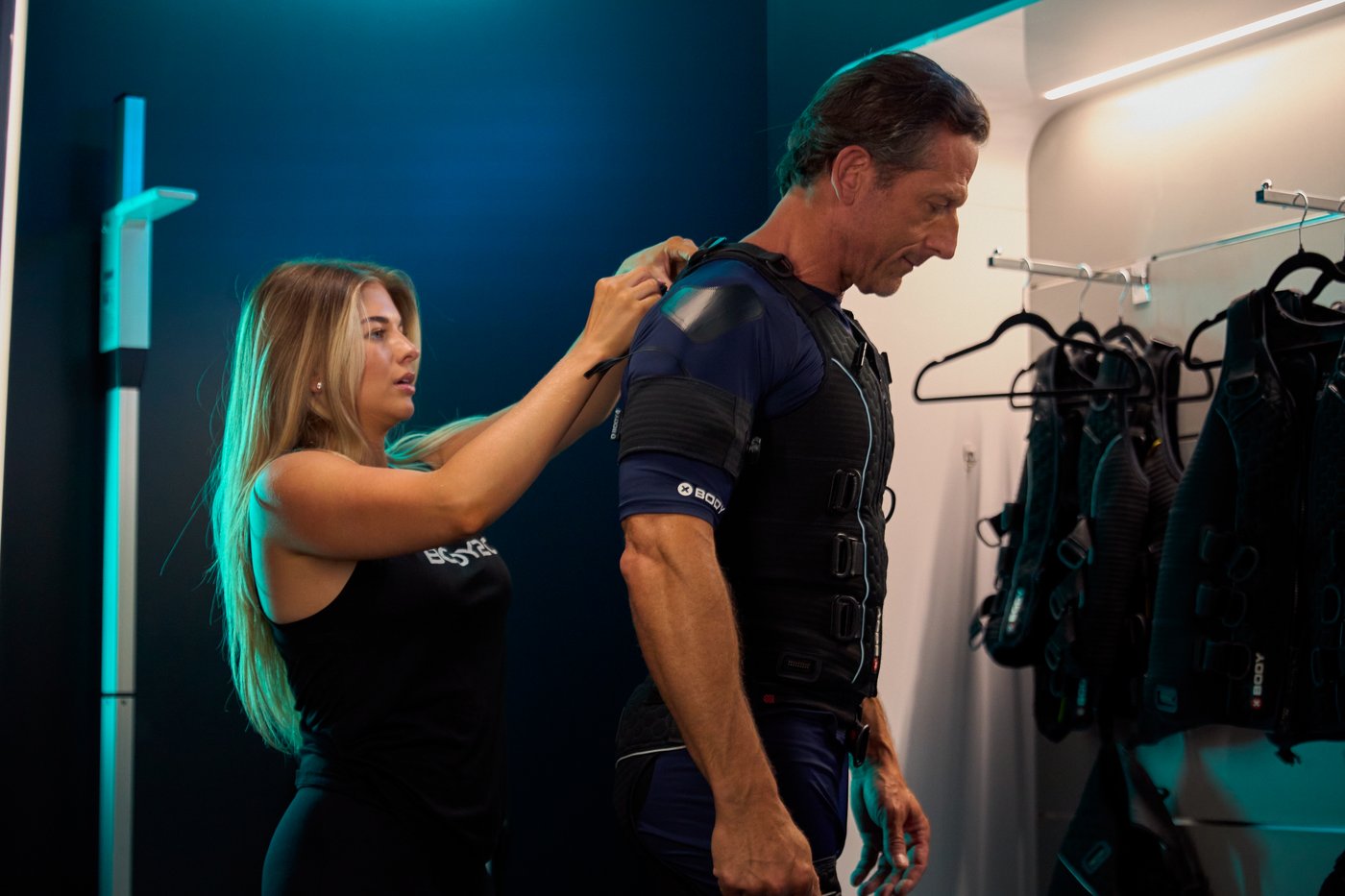
Using a specialized suit embedded with electrodes, WB-EMS simultaneously activates up all the major muscle groups via low-frequency electrical impulses while you perform light, guided movements. The stimulation intensity is independently adjustable for each region, which means your coach can dial up activation in the glutes and core while keeping the impulse minimal around a recovering knee or shoulder. The result is deep, effective muscle recruitment without the compressive joint forces that make conventional exercise inaccessible or unsafe for rehabilitation patients.
The Evidence:
Knee Osteoarthritis
One of the most robust areas of WB-EMS research concerns knee osteoarthritis (OA), a condition affecting millions of adults and one of the most common reasons people believe strength training is no longer an option.
A 2024 randomized controlled trial published in Scientific Reports assigned 72 overweight adults with symptomatic knee OA to either WB-EMS training or a usual care group receiving physiotherapy over seven months. The WB-EMS group showed an 18.2% larger improvement in pain scores compared to the physiotherapy group, with a statistically significant between-group difference of 9.0 points. That is WB-EMS outperforming conventional physiotherapy in a direct comparison.
A companion MRI study, the EMSOAT trial, examined structural changes in the same cohort and found that far fewer knees in the WB-EMS group showed cartilage worsening compared to controls (18% versus 40%). For someone managing early-to-moderate OA, evidence that training can not only reduce pain but potentially slow the structural deterioration of the joint is a meaningful development.
Chronic Low Back Pain
Chronic low back pain is the single most prevalent musculoskeletal complaint worldwide and the one most likely to send people into a cycle of avoidance, deconditioning, and worsening symptoms. The WB-EMS research in this area is both extensive and encouraging.
A 2018 randomized controlled study published in the Journal of Pain Research found WB-EMS to be an effective, time-efficient method for reducing chronic nonspecific low back pain at just one 20-minute session per week. A larger multicenter randomized trial subsequently compared WB-EMS directly against a recognized back-strengthening exercise program. The WB-EMS group trained 20 minutes per week versus 45 minutes for the conventional group and achieved comparable clinical results in significantly less training time.
What makes these findings particularly relevant for rehabilitation patients is the mechanism at work. Research published in PLOS ONE confirms that WB-EMS specifically activates deep spinal stabilizing muscles, including the lumbar multifidus and transverse abdominals, the very structures that become inhibited and atrophied in chronic back pain sufferers. A 2025 systematic review and meta-analysis pooling five studies confirmed a meaningful pooled pain reduction effect and a functional improvement, reinforcing WB-EMS as a clinically significant intervention.
Shoulder Rehabilitation
Shoulder injuries, particularly rotator cuff pathology, present a unique rehabilitation challenge. The shoulder demands stability from surrounding musculature, yet most post-injury or post-surgical protocols restrict movement for weeks at a time. Muscle atrophy during immobilization is a primary driver of poor long-term outcomes.
A study by Schulz et al. (2010), focused on the efficacy of WB-EMS for enhancing strength and jump performance while highlighting its utility in athletic rehabilitation. The researchers observed that WB-EMS allows athletes to mitigate performance declines following injuries by supporting the reconstruction of muscles through stimuli that are difficult to achieve via voluntary training alone. Because the WB-EMS suit places electrodes directly on the shoulders and upper back, it facilitates the simultaneous activation of multiple muscle groups, which is essential for reestablishing scapular stability and maintaining proper joint mechanics.
A 2025 meta-analysis reviewing electrical muscle stimulation applications following shoulder surgery found that EMS produced significantly greater pain reduction than standard rehabilitation alone. Disclaimer: they used NMES which are separate pads that you can place on different muscles, not WB-EMS, same concept of technology, but used differently.
What This Means for You
The common thread across all of this research is the same principle that drives everything at BODY20: strength is not the enemy of recovery. The absence of strength is. Muscle protects joints, stabilizes the spine, and prevents future injury. The question for rehabilitation patients has never been whether to rebuild strength. It has been how to do it safely.
WB-EMS answers that question. With individually adjustable stimulation, no requirement for heavy loading, and a growing body of clinical evidence behind it, this technology represents a genuine advancement in how we approach rehabilitation-phase training. At BODY20, our coaches are specifically equipped to work around injuries, customize intensity by region, and build programs that strengthen without aggravating the very issues that brought you through our doors.
If you are recovering from injury and wondering whether training is even an option right now, the answer, more often than you think, is yes. You came to the right place!
About the Author
Conrad Sanchez, M.S. Kinesiology, is a leading Whole-Body EMS (WB-EMS) educator and expert with over a decade of experience. He holds a Master's degree in Kinesiology and specialized certifications from the world's top EMS manufacturers. When he isn't staying current on the latest WB-EMS research, you can find him helping the next generation of BODY20 members reach their peak potential.